

From 2019 to 2025, Chiara Hübscher completed her doctorate while working full-time as part of the cooperative doctoral programme at the Ingeborg Gross Graduate Centre of HSBA and the University of Twente. Her thesis focused on the topic of ‘Marketing Education for Sustainable Development’. She concentrated on the connections between marketing and sustainability, particularly on the question of how future marketing managers can be trained to become ambassadors for sustainable development. Chiara Hübscher was supervised by Prof. Dr. Susanne Hensel-Börner at HSBA and Prof. Dr. Jörg Henseler at the University of Twente. We spoke to her about her field of research and the results of her work.
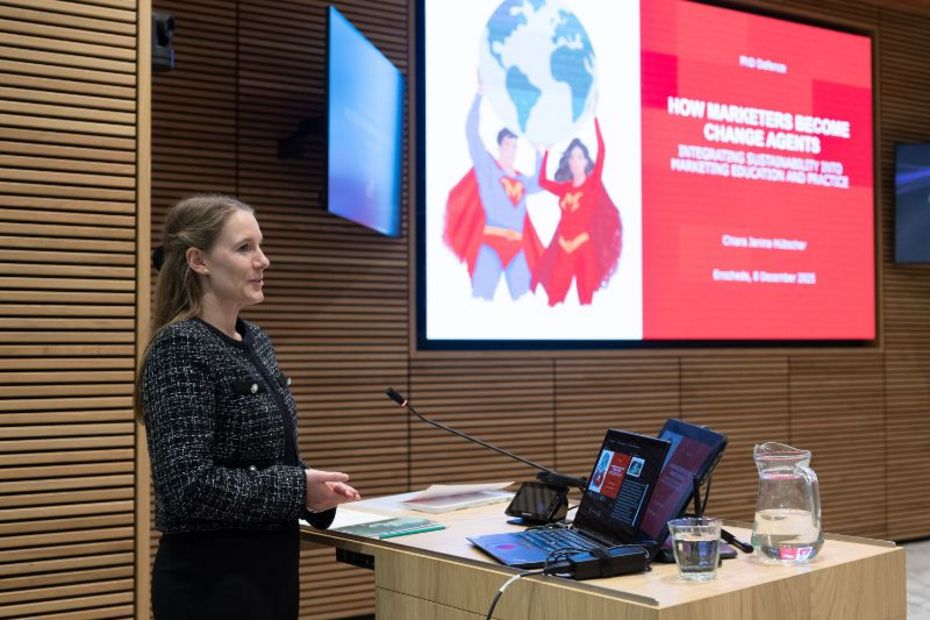
Dissertation: How Marketers Become Change Agents – Integrating Sustainability Into Marketing Education and Practice
How did you become aware of your field of research?
After completing my master's degree with a focus on marketing at HSBA, I asked myself: Am I actually well equipped for the world of work? What trends will influence how we work in the future? What is and will remain relevant in terms of content? What skills are needed in the job market? Based on these questions, which were extremely interesting to me personally and important for my own professional development, I developed the topic for my dissertation. One of the megatrends shaping the world of work was and is the topic of sustainability and the necessary transformation towards a sustainable economy. Since I had specialised in marketing and was also professionally at home in this field, I narrowed down my research field to marketing, but included both education and marketing practice in my work.
What is the focus of your doctoral thesis?
My doctoral thesis is entitled: How Marketers Become Change Agents – Integrating Sustainability Into Marketing Education and Practice. In my thesis, I examine the question of how (marketing) managers become agents of sustainable development from two perspectives – that of training future marketing managers with a focus on the necessary skills and teaching and learning methods for acquiring these skills; and the perspective of corporate practice, focusing on the drivers and barriers that (marketing) managers encounter in their everyday work in relation to sustainability.
What are the most important findings of your doctoral thesis?
The doctoral thesis highlights the importance of marketing and the training of future marketing managers for sustainable development. On the one hand, the doctoral thesis provides a good overview of the current research landscape. On the other hand, the findings of the thesis show, from the perspective of marketing education, how a study programme should be designed so that students can contribute to sustainable development as change agents and encourage others to behave more sustainably as well. From a business perspective, the findings provide an understanding of the factors that enable the implementation of sustainable marketing, and the resulting model offers a tool for measuring the acceptance of sustainable marketing among marketing managers.
Are there any findings or discoveries that particularly surprise you?
Many of the findings closely mirrored my previous expectations, but I would like to highlight two results that did surprise me. Firstly, although sustainability occupies such a large space in current social and political discourse (or at least did so when I began my PhD), one of my studies showed that marketing research has focused much more intensively and deeply on topics such as digital transformation and, more recently, artificial intelligence. This surprised me less than it bothered me, because I am convinced that one cannot function in the long term without the other. I therefore hope that future research will consider the topics of digitalisation/AI and sustainability more closely together and link them more closely. Secondly, in my everyday professional life, I often find that sustainability managers are intrinsically driven and promote the topic on their own initiative. However, the quantitative study in my doctoral thesis emphasises how important external influences are, and in particular how sustainability managers perceive these influences. My study showed that presenting sustainability as an opportunity is a greater driver than presenting it as a potential risk. This is a particularly noteworthy finding in the context of the current debate on sustainability reporting, etc.
How relevant are the results of your work for your professional future?
Among other things, the focus on sustainability in my dissertation has enabled me to develop professionally in this regard. At my current employer, I am strategically promoting the topic of sustainability and implementing related issues. In particular, I am benefiting from the results of the quantitative study in my dissertation, which addressed the question of when and why (marketing) managers promote and implement sustainability in practice, and what prevents them from doing so.