

Quality Management
Accreditations, Surveys & RankingsOur Self-Concept
At HSBA, quality management and a true openness to suggestions for improvement and feedback are assured. We see quality control as a strategic development task that does not serve an end in itself, but is directly linked to the university's strategy and development plan, which is updated continuously.
Accordingly, quality management is a complementary management tool that best supports the process of decision-making, policy development and implementation. We, who work or study at HSBA or are active as cooperation partners, are the protagonists of quality improvement: We negotiate quality in dialogue with each other and, from a multi-perspective, find the best solutions for our challenges.
In order to ensure the indispensable continuous improvement process, we use various instruments of information gathering and action development. Regular evaluations are just as important as the participation in external rankings and the feedback from the various accreditation procedures. Anonymous surveys and personal exchanges complement each other, small and large teams work together in solid and in free constellations.
The System-Accredited University
In July 2025, the German Accreditation Council renewed HSBA’s system accreditation. The successful procedure included two on-site review visits conducted by an expert panel appointed by the Foundation for International Business Administration Accreditation (FIBAA). The reviewers examined HSBA’s overall quality management system as well as selected aspects of programme design, delivery, and quality assurance on a sample basis. The central question was whether HSBA’s quality assurance system systematically ensures that its degree programmes comply with the Accreditation Council’s requirements for programme accreditation.
The review panel stated:
"HSBA’s quality management system is well thought out, logically structured, and operates reliably. It has matured over the years and is embraced across the university with genuine commitment and professionalism. The university has developed a clear quality strategy with defined quality objectives, set out in its mission statement. Reflection and continuous improvement play a key role and are deliberately embedded in its processes. The feedback loops are coherent and systematically closed. All aspects relevant to system accreditation are comprehensively covered."
With the successful renewal of its system accreditation, the Accreditation Council confirms the effectiveness and reliability of HSBA’s internal quality assurance system. This enables the university to independently and flexibly further develop existing programmes in line with its strategic objectives, design new programmes, and conduct independent quality evaluations in accordance with nationally defined standards.
Quality assurance is carried out through internal accreditation procedures conducted autonomously by HSBA in compliance with national quality requirements. The review panel consists of two external professors, a representative from industry, and an external student member. Based on documentation prepared by the university, the panel evaluates each respective programme. In addition, discussions with all stakeholder groups involved in the programme—including faculty, administrative staff, students, alumni, and corporate partner companies—complement the written review. If the outcome is positive, an independent Accreditation Committee established at HSBA awards the seal of the German Accreditation Council.
Accreditation Wissenschaftsrat
Within the framework of institutional accreditation, the Accreditation Committee of the “Wissenschaftsrat” examines whether a private university meets the recognised scientific standards with regard to teaching and research achievements and whether the constitutive requirements for university formality are fulfilled. In 2024, HSBA has, again, successfully passed this procedure guaranteeing a transnational quality assurance of non-state universities. As such, the institution has been reaccredited by the “Wissenschaftsrat” for a further five years.
The statement on the re-accreditation of HSBA Hamburg School of Business Administration, Drs. 2111-24 of 25.10.2024 can be found here.

Comprehensive Evaluations and Feedback Options
At HSBA, there are various internal evaluation tools that are implemented in all study programmes and are based on the Student Life Cycle. They generate information about various aspects of the study courses and systematically improve the quality. The focus of the data collection are the students, who are asked for feedback with the majority of the internal evaluations: After the beginner survey, all courses are evaluated and reflections and short interviews are carried out until the students are asked for an overall feedback shortly after completing their studies. As alumni, they are again asked for their assessment a few years after leaving university. Additionally, companies and lecturers also systematically record and exploit feedback.
In addition to the formalised procedures, informal feedback from the various stakeholders (applicants, students, graduates, alumni, companies, politics, etc.), the HSBA staff receives in committees, at events, at trade fairs, etc. will also be shared. In addition, there are various opportunities for employees to exchange views and contribute their feedback.
Participations in Rankings
HSBA regularly participates in the rankings of the Center for Higher Education Development (CHE). The CHE University Ranking is the most comprehensive and detailed ranking system for German-speaking higher education institutions. It is geared primarily to new and existing students, but has also become established at universities as a fair, informative and qualified source of information. In addition to facts on the course of studies, teaching, facilities and research, the ranking includes ratings by more than 250,000 students regarding the study conditions at their university. All of the results are available free of charge on the internet.
Annual Quality Report 2024/2025
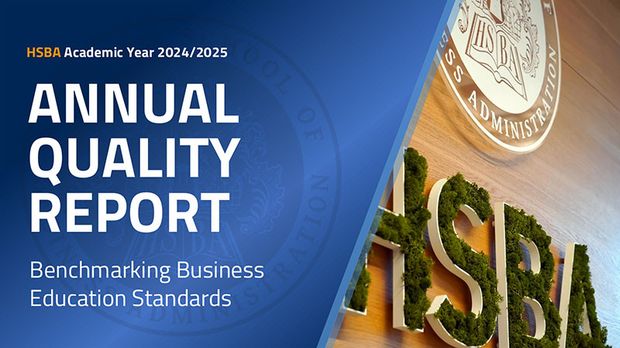
Once a year, the " Annual Quality Report" is prepared by the quality management department in cooperation with the employees of the various departments and committees. It looks back on the previous academic year and presents the quality improvement needs and actions taken to the interested public. It also informs about the committees and instruments used and makes the quality improvement process visible.
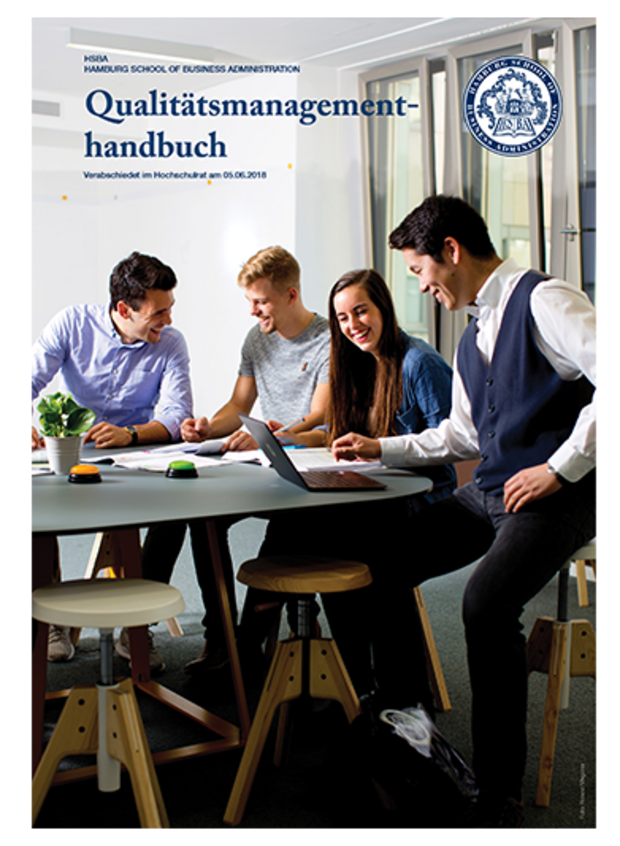
Quality Management Manual
In order to document the organisational anchoring and operational implementation of quality management and to give an overview of our quality objectives, our organisational structures and our quality management processes, we have developed a quality management manual. It is primarily aimed at the HSBA team and selected external partners. Here you will get an insight into the content and structure of the manual.
Process Modelling According to BPMN
In particular, the core processes in the area of study and teaching are uniformly documented according to the Business Process Modell and Notation (BPMN). Internal processes are represented graphically in BPMN in a standardized way in order to ensure a common understanding of performance cooperation in the organization and, if necessary, to be able to adapt quickly to new internal and external conditions.
When designing processes, HSBA consciously pursues a very pragmatic approach, which leaves all persons involved a certain amount of freedom for an individual design of the processes in order to prevent overregulation and increase the acceptance and motivation to contribute to quality.
Make data-based decisions with the degree programme reflection
The degree programme reflection (“Studiengangsreflexion”) tool is a newly developed quality assurance instrument. It systematically processes data from all areas of the university in order to look at key figures and enable data-based decisions.
After the first planning stage, development of prototypes and several feedback rounds, this instrument has been available for general usage since 2021. The programme directors, programme management and the university management use the tool, benefitting from up to date data due to regular updates.
The tool displays key figures and threshold values from surveys and the student registry offices, as well as sales and economic key figures. The data is compiled in dynamic dashboards using Power BI and can be adapted and visualised according to the information need using specific filter functions.