

Entrepreneurial Success Stories at HSBA
Inspiring founder journeys that showcase entrepreneurial spirit, resilience and real impact.HSBA alumni found successful companies across a wide range of industries – from food and retail to FinTech and digital business. Their success stories demonstrate how entrepreneurial thinking, practical relevance and decisiveness pave the way to self-employment.
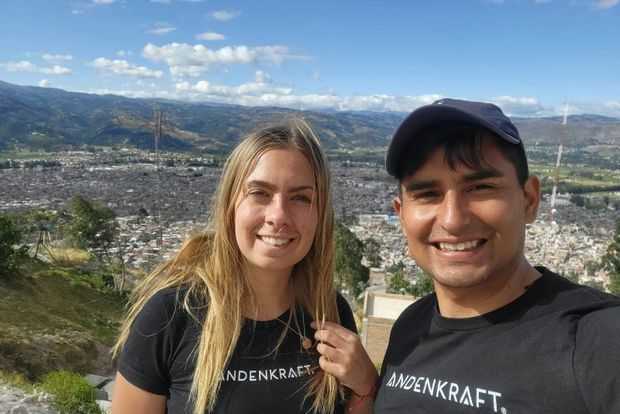
FoodTech: From the Classroom to Television
Maren Gomez Moreno on the impact of the public pitch stage on television and the concept of Andenkraft
HSBA alumna Maren Gomez Moreno will probably never forget this moment: her partner in business and life, Justinian, presented their joint start-up, “Andenkraft”, to an audience of millions on Germany’s most famous start-up show, “Die Höhle der Löwen”. This TV appearance caused Andenkraft’s brand awareness to skyrocket in no time at all and significantly increased demand for products made from the yacon fruit of the Peruvian Andes overnight. In this interview, Maren tells us how she made it from the first presentation of her business idea in the ‘Consulting Project’ Master’s module to the public pitch stage on television.
Andenkraft appeared on the TV show “Die Höhle der Löwen” this year. How did you feel when your co-founder Justinian presented your start-up to an audience of millions?
It was a very emotional moment for me. A mixture of pride, joy and also a certain amount of nervousness. Seeing Justinian standing there, not just presenting our product but also the story behind it, his family, our partners in Peru and our shared vision, was something very special.
At the same time, of course, you know: this is a once-in-a-lifetime opportunity. Millions of people are watching you at this very moment. And that’s exactly why, for me, it was above all a moment when I thought: Now we can show what we really stand for.
How did the idea for Andenkraft come about?
The idea for Andenkraft emerged from two worlds that came together for us. On the one hand, there is Justinian’s personal story: he grew up with Peruvian roots and experienced at an early age the role that plants and natural foods play in the Andean region. This knowledge has been passed down there for generations.
On the other hand, we observed everyday life here in Europe: many people want to eat more healthily, consume less sugar and improve their health, but most products in the supermarket are either highly processed or still full of sugar.
The key question for us was: Why is healthy eating often so complicated, and why are there so few natural alternatives suitable for everyday use? This is exactly what we associate with Andenkraft. We bring traditional plants such as the yacon root from the Andes to Europe, in a form that is simple, delicious and easy to incorporate into everyday life.
You did your Master’s at HSBA. Was there anything that particularly helped you with your start-up idea and still does today?
Definitely, especially the strong practical focus of the course. What helped me in particular was the opportunity to work on real business ideas whilst I was still studying and to test them time and again, whether in case studies or in pitch situations in front of lecturers and other students.
Courses such as Mike Fischer’s entrepreneurship course or product development in particular showed me how important it is not just to think through ideas theoretically, but to actually develop them further, seek feedback and adapt them.
Another key point for me was the decision to continue a project from my studies and seriously explore whether it could develop into a real business model. This mindset – of seeing things not just as a ‘university project’ but as a potential starting point for something bigger – has stayed with me to this day.
Did you secure the deal, and has anything changed for you and Andenkraft since the TV appearance?
We left the show having shaken hands with Judith Williams and Frank Thelen. Afterward, we engaged in more in-depth discussions. We haven’t yet reached a final strategic agreement, so the deal isn’t finalized at this point.
But what has definitely changed is the development of Andenkraft: The TV appearance gave us a huge growth boost, both in brand awareness and in direct customer reach.
We were able to reach millions of people who face exactly the challenge we want to solve: consuming natural, delicious, and simply less sugar to positively support their health.
At the same time, the increased demand has also allowed us to further expand our impact. Every purchase helps us continue to advance our water project in Lima and provide more families with access to clean drinking water.
What advice would you give to HSBA students who would like to pitch a business idea to investors themselves one day?
My most important piece of advice is: Just get started.
That doesn’t mean starting unprepared, but many people spend too long thinking, planning and perfecting. Especially at university, we’re often taught to analyse things very thoroughly, which is important too.
But entrepreneurship works differently: you learn the most when you start putting things into practice, make mistakes and iterate from there. I wish I’d taken that step sooner myself.
That’s why my clear recommendation is: test your ideas early on, talk to real customers, get feedback, and have the courage to go out there even with something that’s not quite finished, because in the end, it’s not the perfect PowerPoint that wins people over, but the ability to solve a real problem and develop a working business model from it.
modell zu entwickeln.

Mobile Advertising: “Don’t blindly follow what TechCrunch tells you to do”
An interview with applike co-founder and CEO Jonas Thiemann on his journey to success, the lessons he’s learned – and the art of asking for advice.
HSBA alumnus Jonas Thiemann showed an entrepreneurial mindset early on. While still studying at HSBA, he began developing the concept for his first start-up. In 2015, three years after graduating, he co-founded the mobile advertising platform applike together with Carlo Szelinsky under the umbrella of Gruner & Jahr – making it one of the largest German spin-offs at the moment. Today, applike has achieved unicorn status, is highly profitable and delivers advertising solutions in more than 100 countries worldwide.
In our interview with Jonas, we talk about why he didn’t pursue a career as a pianist, how applike came into being, what he learned from his first start-up, how to reach a state of flow – and how to stay grounded despite international success.
Dear Jonas, for a long time you had planned to study piano, but you ultimately chose to pursue a dual degree in Business Administration at HSBA instead. When did you realise that you wanted to start your own business?
Taking control of my own life was important to me from a very early age. During the final months of my studies at Otto, I realised that I wanted to move towards the start-up world. At the time, I even pitched an idea at Otto. It was well received, but ultimately not taken forward.
After graduating from HSBA, I spent a year pursuing several start-up ideas, none of which proved successful. I then joined Gruner + Jahr, a company within the Bertelsmann Group. A year later, my co-founder Carlo and I succeeded in convincing Gruner + Jahr to support us in founding a new company.
The story of applike is a success story that shows how a start-up can emerge from within a large corporation. For a variety of reasons, this rarely works in practice—but it is possible, and that is precisely what makes the applike story so compelling.
Can you briefly explain what applike is?
applike is a leading mobile advertising platform. We advertise on smartphones and essentially solve two problems for our app and mobile game partners: We help them attract new users. Every mobile game and every app needs new users, which is not so easy with almost five million apps now available in app stores. That's why we specialise in user acquisition. But we also serve the monetisation side, helping mobile games and apps earn money from users by displaying advertising. With almost 450 employees from over 50 countries, we develop software that helps apps with these two issues. That is the main focus of the applike group. Formularende
Before you founded applike with Carlo Szelinsky in 2015, you tried your hand at Copay, a business idea you had already explored in your bachelors thesis. Why wasn't Copay a success? Was it an important experience along the way?
At Copay, Carlo's and my first company, we distributed online shop vouchers at Le Crobag and in the Telekom Shop. We wanted to attract offline customers to online shopping. On the whiteboard, it looked like a nice business model, as both sides were supposed to pay us. Unfortunately, it didn't work out in practice. But we learned a lot from this experience:
Firstly, how to handle money: if, as a young person, you ever felt like you wouldn't be able to pay your rent the following month, it shapes you for life. You handle money differently afterwards. I still feel that way today, even though we have now achieved unicorn status with applike (a company valuation of more than €1 billion), are highly profitable and advertise in over 100 countries. As an entrepreneur, I am very careful with resources and know that every euro we spend has to be earned first.
Secondly, Copay's business model simply wasn't tailored to Carlo's and my strengths. My main interest has always been in building partnerships and strategically aligning a company so that it functions sustainably. We also call this "outsmarting the competition" here in the team. Carlo, on the other hand, is responsible for technology and product: with his teams, he can build a market-ready prototype in just a few weeks better than most people worldwide. That's why applike is such a good fit for us: we are essentially an AdTech company – I stand for "Ad", Carlo for "Tech". Copay, on the other hand, was basically an offline business, and we couldn't leverage Carlo's strengths there in particular.
And thirdly, I understood how important scalability is. A technology- or product-based business is much easier to scale because revenue can grow much faster than costs. Getting there is challenging, but it leads to incredible opportunities for employee development and, of course, growth in company value.
How did you come up with the idea for applike?
During my early days at Gruner & Jahr, I worked in mergers and acquisitions, where I spoke to many start-up teams from an investor's perspective. That inspired me and gave me energy and ultimately led us to launch the applike idea.
At the time, I had an idea book in which I had written down at least 100 ideas. The first version of applike came from this book and was an app that rewarded users for trying out mobile games, a loyalty programme for mobile games, so to speak. The mobile gaming market is huge and very lucrative, so we started generating installations for mobile games through our loyalty app. The game providers paid us for this.
Over a period of two years, we continuously improved our concept and basically went through the entire value chain of marketing, product optimisation and monetisation ourselves as app publishers. In the process, it became clear where gaps still exist and where the challenges lie in successfully operating an app. This then developed into today's business model. In addition to our own "reward apps," we now focus on helping apps in the B2B sector become more successful – especially in user acquisition and monetisation of their own user base.
One example is our collaboration with Nectar in the UK, the largest loyalty programme in the country: we operate the "Nectar Game World" in the Nectar app. Users can collect points here by playing mobile games. We provide the entire technology: from the playout logic ("Who sees which campaign?") to fraud prevention and all the mechanics of rewarded advertising. We integrate this solution into leading cashback and loyalty programmes worldwide.
Along the way, we have built up further business areas in video advertising and games development. The market has great potential. The largest company in this segment from the USA (Applovin) is now valued at almost USD 200 billion, which is more than VW, BMW and Volkswagen combined. In comparison, we are only just getting started.
You have described the story of applike as an example of how a start-up can succeed when it emerges from a large corporation. Looking back, do you feel this was the right path for you, or would you do anything differently today? What would you say were the key advantages and disadvantages?
I’ve noticed that many people find it very difficult to ask for help — especially business students [laughs]. Out of fear of appearing inexperienced or vulnerable, many end up getting in their own way and accept slower progress as a result. Yet young people in particular can benefit enormously from the experience of others — but doing so sometimes requires putting one’s ego aside.
We were particularly dependent on good advice when setting up an independent company within a corporate group. Such decisions can usually only be made at the highest level, mostly by the CEO in consultation with the supervisory board, especially when it comes to establishing a new business division that includes a stake for the founders. Even though many board members want to promote entrepreneurship, hardly anyone really knows how this can be implemented organisationally and "politically". Large organisations are simply complex, and we learned a lot during this process.
A large strategic investor can be a real advantage: not only does it bring stability, but it also usually has staying power and may be less nervous about the monthly figures – as long as the long-term direction is right. Of course, the overarching goal is always to build something big – but in the beginning, everything is still small and needs time to mature. Personally, I feel very comfortable with a family-owned company as the main shareholder ( ), as we share many values.
At the same time, corporate structures can also be challenging. For example, many companies work with fixed five-year budget cycles. However, it is hardly possible for a start-up to deliver reliable business plans so far in advance – and, naturally, they are often off the mark. This can lead to strenuous discussions within a corporation, especially for those who are responsible for the figures. Personally, I don't really care about annual figures: my job is to build long-term value – for the employees as well as for the shareholders.
All in all, it was definitely always the right decision for us to set up applike together with Gruner + Jahr and Bertelsmann. Financially, the greater risk was always borne by Bertelsmann, while Carlos and I were responsible for building up the business operationally. In return, Bertelsmann holds a majority stake in applike. I am very grateful for this successful partnership.
Despite your success, you have remained refreshingly modest and still appear to be very careful with money. What does money mean to you personally?
Thank you, that’s very kind. Thanks to the company’s success, I am fortunate enough not to need to spend all of my money. Also, my relatively simple lifestyle certainly plays a part.
I was already very conscious of my spending during my studies. If I bought a coffee for three euros, I would immediately work out what that meant over the course of a month and whether it fitted within my budget. Living beyond my means was never an option for me — it was simply something that had been deeply ingrained from an early stage.
I believe that money never really belongs to you alone – it was always part of a larger cycle and belonged to someone else before. Especially when you have more than others, this comes with a special responsibility to be conscious and prudent with money. In our case, people used apps, installed a game and spent money there. The game pays a fee to applike, and at some point in this entire value creation process, part of the money flows back to me. This clearly raises the question for me: where does this money go back to? Ideally, not exclusively to my own account.
Personally, I am particularly interested in projects that deal with new forms of healing mental illness, as well as the promotion of art and culture.
A lot has happened since you graduated from HSBA. Can you still remember how you came to HSBA?
I wanted to study piano for a long time, but I realised that being alone wasn't for me. The daughter of a good friend of my mum's was doing a dual degree at Otto at the time, and that's how I found out about the extremely demanding application process with around 2,000 applicants. It was precisely this challenge that appealed to me at the time – so a certain amount of ego can also be quite useful [laughs]. During the application process, I realised that I really liked the environment and the work. Typical for me as a rather intuitive, decisive person, I didn't weigh it up forever but simply decided to go for it because it felt right.
You studied with Alexander Djordjevic and Ole Schaumberg, the founders of foodist. And Jonathan Kurfess, founder of Appinio, joined us a year after you. Did you know each other?
Yes, we all knew each other back then and are still in touch today. I was actually quite close friends with Ole – we organised a small series of parties together. By our final year of study, it was clear to Ole, Alex and me that we were the ones who wanted to do something of our own after graduation. I was already in the middle of my first start-up. And Jonathan later successfully founded and built up Appinio.
As a dual business school, we want to give our students the tools they need to do what they want to do. That means being successful in a company or going their own way. In your case, it was a bit of both. How would you say that HSBA and your studies helped you to realise your ideas?
The first year of my studies was particularly difficult for me and I didn't really enjoy it. But over time, I realised how valuable everything I learned there was. Today, I use content from my studies every week – whether in discussions with our CFO or with Bertelsmann on topics such as accounting, financial reporting or labour law, or on operational topics such as pricing, marketing and distribution systems. My co-founder often asks me, "How do you know all this?"
Of course, I don't remember every detail by heart, but my studies taught me a certain way of thinking: structured, analytical and solution-oriented. And precisely because I am a very intuitive, gut-driven person, this analytical counterpoint was incredibly valuable to me. I still benefit from it today.
At that time, many entrepreneurs and executives were invited to HSBA, including the founder of the Stern-Wywiol Group and various board members from other partner companies. This made it very easy to see which career path might be right for you. In addition, the fellow students also talked about what was happening in their partner companies. This gave me a broad insight and enabled me to better assess what might suit me.
In my third year of study, Prof. Dr. Ann-Kathrin Harms also ran the "Entrepreneurial Marketing" project as part of the marketing specialisation. There, we developed a business plan for the climbing hall in Wilhelmsburg – a project that was really exciting.
If you wanted to, you could learn an incredible amount from all these opportunities. Looking back, it was a very valuable experience.
Today, you are an experienced entrepreneur and founder who people can turn to for advice. Is there anything you would like to pass on to our students?
Start where you are!
I am now 35 and looking back, I can say that until I founded applike at the age of 25, I often changed my environment quickly as soon as something didn't go well. If my employer wasn't right for me, I looked for a new one. If my circle of friends wasn't right, I changed it. If I no longer enjoyed a sport, I moved on to the next one. Maybe that was a bit extreme at times.
Over time, however, I realised that it's often worth pausing for a moment and asking yourself what you really want. If you want to start a business, for example, you can often get more out of your existing environment than you think. Because what often happens when you change your environment? You take your own patterns with you – and end up in a similar situation again. We humans are strange in that way: in my opinion, we often unconsciously seek out the same problems, just in a new setting. Three years later, you have a new employer, but a lot of things feel the same as before.
That's why I've made it a habit to try to make changes in my existing environment first. Pause for a moment, listen to your inner voice and think: What can I do differently here and now? And often, after just a week, you'll notice that things are going better and that you're happier. If it still doesn't feel right, you can always move on. But first, you should try to make the most of what you have. Often, there's already a lot there.
This is especially true if you want to start a business. First, use what is already there: your fellow students, colleagues, the people next to you in your studies. See what you can develop together from your current opportunities. Don't immediately pack up and move to Berlin and blindly follow what you read on TechCrunch or elsewhere. If you look at successful start-up stories, it's rarely those who simply followed trends – but those who found their own way.
Find out what you are really capable of. Get the most out of your existing environment. And if that doesn't make you successful or satisfied, then change something.
I still remember an event at HSBA where there was talk of "creating the resilient employees of tomorrow." The word "resilient" irritated me even then. Of course, you have to get a lot done in this world, and resilience is important, but the most important skill in professional life should not be to endure as much as possible. The best results come when people get into a flow, when they have fun, develop energy and teams really start to function. If you haven't been in that state for too long, the answer shouldn't be, "Become more resilient." Instead, find an environment that suits you – one where this flow is possible in the first place. Then success and satisfaction are inevitable.

FinTech: Start-up Prize for HSBA Alumnus
Parto, founded by Christoph Roling, offers payment solutions for social and care institutions
Congratulations! Our MBA alumnus Christoph Roling (MBA Corporate Management) and his co-founders Jes Hennig and Thomas Heuck were recently awarded the GründerGeist, the start-up prize of the Hamburg Economic Juniors, for their innovative idea. With their start-up Parto, they have created a digital payment solution for people in care who previously could not or were not allowed to access their own money and were always dependent on the support of staff in the institutions. This is a considerable effort for everyone involved and, what's more, all transactions take place with cash. Parto wants to change this and enable digital participation with the new payment system. We asked Christoph how the idea for Parto came about and what the biggest challenges were.
Can you explain how the idea for Parto came about?
First of all, thank you for the congratulations! We are really pleased that our project has received so much support. In fact, the industry itself has such a big problem with the issue that the Diakonie Nord Nord Ost from Lübeck has been looking for a solution through its network. With the experience from our previous company, where we provided cards and accounts for Gen Z – including pocket money accounts – we were approached as part of a feasibility study. The more we looked into the topic, the clearer it became that a solution was needed that went beyond an individual project. This is how Parto was founded.
How exactly does your digital payment solution work?
Parto offers the organisations running the care facilities, for example a Diakonie Nord, Nord Ost, Caritas or private organisations, a holistic administration software. This includes a company account and a trust collective account, as well as VISA debit cards for employees and optionally for clients. This solution can then be used to manage all the finances in the facilities, including the legally compliant administration of client funds, centrally and efficiently in a single software solution.
This means that employees in youth welfare, integration assistance or geriatric care can use their card to make payments for one or more clients and at the same time also for purchases for the institution, i.e. for business expenses.
However, the organisation can also issue cards directly to the residents of the facility. This allows clients to participate in normal (digital) life and, if necessary, receive educational support from staff.
Parto enables greater participation for people in care while at the same time massively reducing the workload for staff in the facilities.
What was the biggest challenge for you on the road to Parto?
We are dealing with two very sensitive industries. On the one hand, there is a large amount of administrative and legal requirements in the social economy – on the other hand, there are many rules and regulations in the banking sector. Finding a model in which we map the requirements of our customers, enable participation and observe the regulatory requirements of BaFin was definitely the biggest challenge.
And one more question with our students in mind: What advice would you give to young people thinking about starting their own business?
I don't think it's ever been as easy as it is today to turn your own idea into reality. When you start a business, you learn an incredible amount in a short period of time and you are forced out of your comfort zone and challenged in many ways. It's a lot of fun. And it doesn't always have to be cutting edge – you can do it without AI and blockchain.

"Food Is My Passion" – From Founder to Business Angel
Interview with our alumnus and Foodist founder Alexander Djordjevic about food trends, entrepreneurship and content creators
Alexander Djordjevic was already enthusiastic about entrepreneurship during his studies at HSBA. Together with his fellow student and later Foodist co-founder Ole Schaumburg, he set up the HSBA Entrepreneurs Club as a student initiative. After completing his Bachelor's degree, he founded the successful Hamburg start-up Foodist and provided food lovers and connoisseurs with selected gourmet snacks and delicacies from all over the world for ten years. Since his successful exit, Alexander has been supporting and advising young start-ups as a business angel and, with Foodvibez, is working with leading international content creators to develop innovative food brands. We talked to him about food trends and the importance of networks.
You founded Foodist straight after completing your Bachelor's degree at HSBA and went to great lengths to make your dream come true. How and when did the idea come about?
The core idea for Foodist came about with my co-founder Ole Schaumberg in the fifth semester during my HSBA studies. At the time, subscription boxes with beauty brands were very successful in the USA, where customers could discover new beauty products every month. We transferred the concept to food, with the aim of introducing our subscribers to new food brands every month that they wouldn't find in the supermarket. The development and preparation of the launch happened in parallel with the bachelor thesis. In hindsight, that was really exhausting!
At the end of 2022, 10 years after founding the company, you sold Foodist and exited completely. How did the exit come about? Did you have a plan for when you wanted to leave Foodist?
I set myself an end date for my time as CEO of Foodist and this end should be accompanied by an exit that is satisfactory for everyone - employees, investors, partners and myself. A great tip I received on this: You have to define a specific time frame. Even if not everything goes according to plan and it doesn't end up with the sale of the company, you can then immediately start to set the right course and make important decisions. I found a period of a thousand days to be good, that's far enough away to plan everything and close enough to take action and not put anything off.
After the exit, you advised and supported several young companies as a business angel. How does it feel to suddenly be on the other side?
It's a great privilege to invest in the ideas of ambitious founders and support them on their journey. I try to get involved in the way I would like my own investors to be involved or have experienced positively, i.e. to be available as a sparring partner, to lend a sympathetic ear to problems or simply to cheer them on. At the same time, I only get involved when it is desired. Even if, as a founder, I tend to quickly have an opinion on strategy, it is important to trust the intuition of the founding team, who work day and night to develop the company and pursue its mission.
You recently launched your own new thing. What exactly is Foodvibez?
We systematically create innovative food brands with the greatest content creators of our time, which we sell via our online store or stationary retail outlets. The products all claim to be "better for you & the planet". I am totally driven by using the incredible reach and influence of content creators to successfully sell better food and raise awareness about nutrition. Together with Pamela Reif and the development of the "naturally Pam" brand, I have already achieved this once.
Many of our students stay in good contact after their studies, for example via the Alumni Association or the many networking events we offer. How important would you say a good network is for a young start-up, how important was it for you?
A good network is very important in every phase of a company. To be honest, we didn't have a very good network when we started Foodist because we simply didn't have the professional experience. In hindsight, we should have made even more use of the HSBA network. Thanks to the dual approach, HSBA has an association of partner companies and most of the lecturers are very successful in the business world.
What advice would you give our students who are interested in starting their own business, perhaps even in the food sector?
If you clearly feel that you want to start an idea, then go for it! If you already have deep-seated doubts before you start, then don't go for it, as it's a really hard path that involves a willingness to make sacrifices. However, I would still recommend working in start-ups or grown-ups to all those who have doubts, as in my opinion the learning curve is steeper in dynamic companies. If you are in a corporation, try to work in areas where innovation takes place and entrepreneurial thinking is encouraged.

Re-Commerce: Creating, not Just Managing
An interview with Karo Junker de Neui about starting a business and personal learnings
Karolin Junker de Neui is an e-commerce expert and passionate entrepreneur. She was selected by Capital business magazine as one of the "Top 40 under 40" – an award that the magazine has been giving to the young elite every year since 2017. Karo knew early on what she didn't want, but also what she particularly enjoyed and what challenged her. She studied Business Administration at HSBA with Beiersdorf as a partner company, then set up her own business in 2012 with Reverse Retail GmbH to revolutionize the second-hand market for luxury brands and fashion with Vite EnVogue. Today, she is Managing Director at Etribes and advises companies on digital business. We spoke to her about what really drives her, how she got to where she is today and what advice she would give our students.
Dear Karo, since 2021 you have been Managing Director at Etribes, a renowned digital consultancy in Hamburg, and in 2022 you were named one of the "Top 40 under 40" by business magazine Capital, making you one of our country's young elite. Really impressive - did you expect this award?
The award was totally unexpected for me. Of course, a title like this looks nice on a CV or LinkedIn profile, but it doesn't play a role in my day-to-day work. Ultimately, as Managing Director at Etribes, I want the positive added value of our consulting work to be seen by our clients - and that's not a one-woman show. However, access to the Top 40 under 40 community is a significant advantage.
After your studies at HSBA, you worked at your partner company Beiersdorf for a few years before setting up your own re-commerce company. Now you are Managing Director at Etribes and on the advisory board of the private cosmetics retailer Schuback. How did you get to where you are today? What drives you?
I want to work on things that make a difference. I enjoy creating and doing things, not just managing them. After my first job at Beiersdorf, that's what drove me to found my own company. When I founded Vite EnVogue, I learned an incredible amount about e-commerce and entrepreneurship and when my learning curve slowed down after a few years, I wanted to do something new. That's when I came across Etribes and realized that you can create and move a lot even in an employment relationship if it's the right company and the values and environment are right.
Is there anything you would like to pass on to our students?
Experiment and get to know lots of different companies. That way you can find out what you enjoy. If you deal with topics that you really enjoy, you will soon become good at them. And if you do take the wrong path, there is always the opportunity to redirect yourself and benefit from an important learning experience.

Biotech: HSBA Alumnus Achieves Important Breakthrough
Dr Yang Liu founded the first spin-off of the Bernhard Nocht Institut für Tropenmedizin (BNITM) Hamburg
Dr Yang Liu, HSBA alumnus, PhD philosopher and biochemist, and CEO and founder of biotech company Panadea Diagnostics, achieved a significant milestone for his company in March this year. As a spin-off of the Bernhard Nocht Institute for Tropical Medicine, Panadea Diagnostics is now authorised to use the BNITM patents exclusively. In this way, the institute is making an important contribution to better medical care, especially in developing and emerging countries. Panadea Diagnostics specialises in providing high-quality tests for tropical and emerging infectious diseases. We talked to Dr Liu about the special challenges he has faced in recent years, the biotech industry and his studies.
What is the business idea behind Panadea Diagnostics and how did it start?
Since March this year Panadea Diagnostics develops, produces, and sells diagnostic tests for the detection of antibodies against tropical and emerging infectious diseases, such as Dengue fever, Yellow Fever, Ebola etc. We use a patented platform technology that allows tests to have a significantly improved specificity compared to other commercially available test systems. This means that fewer false positive results are displayed, and the conclusions drawn are therefore more reliable.
The story of Panadea Diagnostics though already started a while ago. Around ten years back, we had the idea to commercialize the available patented technology from the Bernhard Nocht Institute for Tropical Medicine in order to develop and market diagnostic kits to test tropical infectious diseases. However, at that time, when I engaged with investors and talked to other experts about this business idea, one frequently asked question was: "Are these diseases curable? If not, why would people spend money on diagnosing them?" which was indeed a very valid and difficult question to address. Together with other factors including a premature stage of production and a limited portfolio of available kits, the idea was postponed for a long time. In the meanwhile, I moved on to work in different pharmaceutical companies in Germany.
Then the COVID-19 pandemic destroyed the global market, caused a disruption and a complete transformation of the market landscape. After the pandemic I finally saw the opportunity to realize the long-held business idea. The question that was frequently raised before had been addressed by market realities: COVID-19 lacks a definite cure, but everybody is willing to invest money on testing it. On top, we came to realize that the customer base extended beyond medical institutions in the developed countries. Every country, every company, school, bank, and so on now has the potential to become a customer for such diagnostic tests. In Germany you could even buy such rapid tests for detecting infectious diseases in supermarkets, which has never happened before. Another change was the grown awareness that surveillance activities, both in human and animal populations, are vital to foresee and hopefully prevent future pandemics.
These observations, coupled with the contributions of my colleagues at the institute, who continued to develop more products during my absence, convinced me that it was time to revive our business idea. Given the overall changes in the market landscape and the mindset of people regarding infectious diseases combined with an increased awareness of biotechnology, the business idea gained significantly more credibility and feasibility for investors. So eventually, we managed to convince the investor and launched Panadea Diagnostics.
Panadea is a spin-off of the Bernhard Nocht Institut für Tropenmedizin (BNITM). What were the biggest challenges in implementing it? How long did the transfer process take?
We are indeed the first spin-off company from BNITM with a series of collaborative agreements. Although the institute was very supportive, the stringent laws and regulations held the process of negotiation and discussion extremely long. All in all it took us about one year to settle only the license agreement because the institute has ownership of the IP, and we are the only one being offering exclusive rights of use for commercialization.
Start-ups in the biotech sector are rather rare in Germany (according to a statement by BIO Deutschland e.V., the industry association of biotechnology companies in Germany, from 2022*) as there is still a rather start-up-hostile climate in the research and development-intensive industries and in knowledge-intensive services. Do you agree/disagree with this statement and how did you manage anyway?
Yes, I do agree. One of the interesting points to discuss is "fairness", in terms of "Beihilferecht (State-aid-law)". The law in general tries to prevent the publicly funded institute/university from "unfairly" supporting a privately held start-up. In principle this is a reasonable idea, but the interpretation of the law goes in the direction of "being absolutely equal to the existing company", which means any condition given to us, a start-up, should not be better than the market condition, meaning the condition given to us should be the same as the condition given to a well-established large company. It might be "equal", but not "fair". In other words, I perceived the climate as very hostile to founders. During our negotiation and discussion with various stakeholders, the fear of violating the law held the decision-maker back.
Additionally, the language barrier poses a significant challenge for numerous international talents aiming to establish a business in Germany. They often encounter intricate tax regulations, insurance policies, and other complexities also. We were lucky enough that the institute made every effort to collaborate with us. Nevertheless, it took us over a year to finalize an agreement and we spent a substantial budget towards seeking external consultation and legal assistance. In many other countries such matters are often overseen by government entities or specialized organizations, particularly to foster the growth of innovative startups.
Did your studies at HSBA help you achieve this important milestone?
Back in 2017, I enrolled in HSBA's Executive MBA programme. The holistic understanding of business management gave me the confidence to be an entrepreneur and minimize the fear of being ignorant. And when I started the company, the knowledge I learned guided me to think about all perspectives, not only R&D for example.
Did you also make use of the mentoring programme as part of your studies?
I’m still in contact with my mentor as he’s a very kind and experienced senior professional. I always very much enjoyed our regular encounters, where I could share my thoughts and get valuable feedback.
Do you have any piece of advice for upcoming entrepreneurs from HSBA?
If even the slightest hint of becoming an entrepreneur exists within you, you should definitely give it a go. I would encourage everyone to try it, although of course it is risky, you have to be patient and motivated at the same time, and you need to spend all your energy on one goal. Even so it is fun and an experience most people don’t have and I wouldn’t want to miss.

Be Gritty! On Passion, Perseverance and Gamified Market Research
Interview with Jonathan Kurfess, founder of the highly acclaimed market research platform Appinio.
In November 2022, HSBA alumnus Jonathan Kurfess, founder of the market research platform Appinio, has been selected as one of the "Top 40 under 40" by Capital business magazine. An award that the magazine has given to the young elite every year since 2017. At the age of 23, he founded Appinio, the fastest and cheapest market research platform in the world, directly after his business administration studies. Today he runs a modern company that is super successful and CO2 neutral at the same time. A great opportunity to talk to Jonathan about his great success with Appinio, his passion as an entrepreneur and what drives him personally.
You have just been named one of the "Top 40 under 40" by the business magazine Capital, making you one of our country's Young Elite. Congratulations, that's really very impressive. Did you expect this award?
Thank you very much! No, I didn't expect it. But it makes you realise that you are getting older. All of a sudden it says 40, although I'm still closer to 30. I wouldn't count myself among any elite and I don't like thinking in terms of elites. Nevertheless, I feel very honoured and proud of our team and everything we have achieved together with Appinio in the past years. Therefore, I was very pleased and am of course even more pleased that the work of the past years is being recognised.
You had the idea for Appinio in your early twenties. How did you come up with it? What was the trigger?
The idea for Appinio actually came to me during my studies at HSBA. Since the degree programme has a dual structure, I also worked in the marketing department of my cooperation company at some point. As a budding "marketer", I was always dependent on data from market research. Even back then, I found the process of obtaining the data incredibly tedious and very inefficient. First talking to the internal market research department, who then approached a market research institute, who then approached service providers, who recruited participants, who were interviewed and back again. The whole process took several weeks, was incredibly complex and extremely expensive. At the same time, the data was extremely poor because the only incentive for survey participants was to make money.
That was the time when social networks like Facebook or Instagram became big. I wondered why people left and right were starting to publicly voice their opinions - intentionally or not - except in market research. And when you break it down to the most basic level, market research is just that: asking consumers for opinions.
That's where I got the idea for Appinio - a social network for opinions, monetised via market research. I pitched the idea to my employer at the time, but they didn't want to pursue the concept. After completing my studies, I founded Appinio.
Did your studies at HSBA help you to realise your dream? Or to put it another way, is there perhaps a special moment, a special aspect from your time as a student that was particularly helpful?
It's fair to say that without my dual study programme, I definitely wouldn't have been able to understand and experience certain contexts, such as how inefficiently market research works. Therefore, I would never have founded Appinio without HSBA. As far as the foundation itself is concerned, it was a lot of learning by doing. You learn a lot during a dual study programme, except how to set up your own company. At least that's how it was for me at the time. That's not necessarily the purpose of a dual study programme. But I have to say that the practical experience was incredibly valuable and certainly an advantage for me compared to others. I am and will remain a big fan of dual studies!
Appinio is not a pure survey app, but rather a social network for opinion with exceptionally engaged users. The incentive is more symbolic. Can you explain that briefly?
With pleasure. As I just briefly described, there is a very central problem in market research (Mafo for short): the incentive system of the participants. Much of what happens in market research is, to put it bluntly, fraud - and almost everyone knows it. Because participants are only induced to fill out surveys and take part in studies by money. As a result, the data quality is incredibly poor and there are many so-called "survey hunters" who fill out surveys almost professionally just to earn money. If the first question of a survey is: "How many SUVs do you own?", for example, they give five, because they will then most likely receive highly paid automotive Mafo.
That is exactly what we are changing. Market research is not the core of the app for our users and not the reason why they use the app. It's because we've built a community-based social network that users love to use. They like to open the app and express their opinions. In other words, an incredible number of opinions are shared in the app, questions are asked and users can compare and question each other.
Every now and then, there is also a real Mafo survey. But since our users are almost addicted to the app, they like to fill out the surveys with a conscience. In return, they get coins and move up in levels. The app is therefore very gamified and the coins are more symbolic. You get a few cents for completing a survey. When a user has filled out enough surveys, he/she can have the coins paid out via Paypal or donate them.
This not only has the advantage that our data quality is far better than traditional market research. We can also offer it at a significantly lower price and thus make it possible for new companies to conduct market research in the first place. In addition, we are incredibly fast. A nationally representative survey with 1000 participants takes less than 1 hour.
You always wanted to make the world a little better and you actually did it. Today (as of 2022) you are a C02 neutral company and still donate 1% of your turnover to the fight against climate change. You can be more than proud. How did you manage that?
Exactly, we are a C02 neutral company and have committed to donating 1% of our turnover to climate protection. With Appinio, we also plant a tree for every survey that is commissioned from us. Appinio is bootstrapped, which means we don't have institutional investors on board telling us what we should and shouldn't do. This allows us to do things differently than other companies and competitors. For example, donating 1% of our turnover.
With Appinio, we want to set an example and show that ecology and commercial success are not at odds with each other, but quite the opposite. Sustainability is discussed and propagated a lot, but if we look at how we build companies nowadays, it is anything but sustainable. Many simply borrow an incredible amount of money for maximum growth and hope that it will work. Unfortunately, we are currently seeing that it often doesn't work out, left and right, with all the waves of redundancies. We want to prove that things can be done differently. So far with success.
We are also working on our own foundation. We want to make it even easier for other companies to do the same and also donate a part of their turnover to the environment and receive C02 certificates in return. We want to inspire other generations of founders and companies to do good and change the system from within by proving that social capitalism is the successful and sustainable, social and contemporary way to build and run a business in today's world.
Is there any advice you would like to give to our students?
I believe that patience and perseverance are often underestimated. The journey with Appinio was anything but easy and involved a lot of hard work. We were on the verge of exodus several times because we had hardly any money left in our account. If I hadn't believed in myself, the idea and especially the team at those moments, we wouldn't be where we are today. There is a word in English called "grit". Grit is the combination of passion and perseverance. If I could give students one thing, it would be "be gritty". Success is much less determined by talent than many think. It's much more about passion and perseverance. So don't give up after the first setbacks!

Neuromarketing: How to be Successful with Luxury
Interview with our HSBA master alumna and founder Caroline Grauel about neuromarketing in the luxury segment
“Luxury has become quieter,” explains Caroline Grauel, a recent HSBA Master’s graduate and founder of the consultancy Minding Luxury. With her company, she aims to bridge the gap between academic research and business practice, making research insights applicable – particularly for luxury brands. In this interview, she talks about shifting consumer expectations in the luxury sector, emotional triggers in purchasing decisions, and how she found her own path.
In her new position at the Deloitte Neuroscience Institute, Caroline Grauel deals with consumer neuroscience and consumer behaviour, i.e. it is about investigating and measuring which processes in the brain influence purchasing decisions and making this knowledge usable for marketing. This is an area of research that she already dealt with intensively in her master's thesis, which was supervised by Professor Dr. Inga Schmidt-Ross - especially with regard to the luxury hotel industry. But that is by no means all. With her freshly launched consulting company Minding Luxury, Caroline Grauel has fulfilled another dream and wants to build a bridge between science and practice and make the knowledge gained in research applicable to luxury brands in particular. A doctoral thesis on the topic is also already being planned. We talked to her about the needs of today's luxury consumers, about which emotional triggers play a role in the purchase decision and brand perception, how the luxury hotel industry can successfully position and differentiate itself online, and what she would give our students to take away with them.
Dear Caroline, you have been dealing with neuromarketing in relation to luxury brands for some time, especially in the luxury hotel sector. How did your interest in this particular combination of topics come about? Have you created a niche here?
I completed my bachelor's degree in dual studies at TUI AG and subsequently worked there as an executive assistant in the cruise sector and as an investment controller in the hotel sector. My interest in the tourism industry was therefore awakened very early on. In today's market environment, I have the impression that it is becoming more and more difficult to really inspire guests in the luxury segment, not only to fulfil their expectations, but to exceed them and to remain in the guest's memory for a long time. Especially in the luxury hotel industry, the demands are very high and differentiation from the competition is crucial.
I therefore ask myself "What makes the luxury guest tick?" "What are their deepest needs?" and also look beyond the luxury hotel industry to fundamental questions such as "Why do we consume luxury goods at all? What's behind them?"
In the field of neuromarketing and consumer behaviour, there are already several studies that show how and why purchasing decisions are made, which so-called biases [certain behavioural distortions and tendencies] play a role in this and how brands are perceived by our brain. However, there is very little research in this area specifically geared towards the luxury goods industry and the luxury hotel industry. I have gone deeper into this field and would like to develop it further in the future. I am convinced that there is new potential here for luxury brands and the luxury hotel industry.
The definition of luxury has changed fundamentally in recent years. From the point of view of a neuromarketing expert, are there differences in the marketing of luxury brands compared to "normal" brands and products? Or asked differently: why do people buy luxury products? What factors are decisive?
[laughs] "That's very nice of you, but I wouldn't call myself a neuromarketing expert. There are many researchers who are much deeper into the subject. I am at the very beginning of my journey. What sets me apart is a good understanding of the needs of the luxury guest coupled with curiosity and the question of "why" when it comes to purchasing decisions and brand perception in the luxury segment and the luxury hotel industry.
There are various theories as to why people consume luxury goods. From a behavioural science perspective, consumption can be explained by the demonstration of superiority or the survival of the fittest. Let's look at the animal kingdom, for example: male birds with the most ostentatious plumage impress females the most and are most likely to mate because they show superiority over their male rivals. Some "show-off" behaviour can also be observed in us humans. Group membership and social separation from others are also influencing factors. Overall, the phenomenon of luxury consumption is very complex and multi-layered.
For example, researcher Prof. Diana Derval, who teaches at the Sorbonne Business School in Paris, found that our tendency to consume luxury goods as adults is already determined to a certain extent by hormone levels in the womb before we are even born. The more testosterone there is in the womb, the more we feel the need as adults to distinguish ourselves from others through status and consumption and thus demonstrate our superiority. Whether increased luxury consumption shows superiority over other individuals from a value-oriented point of view remains to be seen.
With regard to brain research, it has been shown that many factors have an influence on us when making purchasing decisions. Rational reasons make up a part of our decisions, but our emotions and imprints also have a very large influence on our purchase decisions. If a luxury brand succeeds in appealing to our emotions and deepest needs, this has a strong positive reinforcing effect on the purchase decision. But there is no "buy button" in the brain. Our decisions are far too complex for that and there are too many factors involved.
In the end, however, many marketers and managers of luxury hotels already make the right decisions based on their gut feeling. Those who have been working in the industry for a long time know their consumers and their needs very well. From my point of view, neuromarketing is another complementary perspective in brand management and addressing consumers. Understanding the luxury consumer's brain helps us to target consumers better - without much wastage. In the online context, the conversion rate can be increased by creating certain so-called nudges, i.e. incentives for a certain, desired behaviour. The perception of luxury brands has also changed.
For years, the marketing of luxury brands was characterised by exclusivity, rarity and a small, elite circle that could afford luxury goods. Today, this can still be observed, but what is changing is the value system behind luxury consumption. Consumers ask about the meaning of their consumption. It is no longer about mere possession. For some years now, the trend in the luxury segment has been "from having to being". At least, this is how it is often described by researchers and consultants in the luxury segment. Behind this is the need to consume experiences and create experiences and memories in addition to pure possessions. Luxury has become quieter. At least in Western European countries. In China or Russia, this may still be different.
Consumer behaviour in the luxury segment has also evolved considerably in recent years. Consumers want to see a sense in their consumption. And they want to have a clear conscience about their consumption. Production conditions, sustainability and social responsibility also play a role in consumption today. The world of luxury consumption is therefore becoming more and more complex. This makes it all the more important for luxury brands and luxury hotels to stay on track. Sometimes, due to today's increasingly complex and rapidly changing requirements, one can no longer see the wood for the trees. An understanding of the needs and the processes that take place in the brain during purchasing decisions can create great added value here.
Your master's thesis* is about the design of websites for the luxury hotel industry. However, online distribution actually established itself very late in the luxury industry - can you briefly explain why?
Online retailing was comparatively late to enter the luxury segment because for a long time, the opinion prevailed that basic pillars of luxury marketing, such as exclusivity, rarity, a limited availability and a certain touch of the unattainable, did not go hand in hand with online retailing. There was a fear of a certain demystification of the luxury good or the luxury brand. Moreover, marketing in the luxury goods industry and especially in the luxury hotel industry, which is part of the service sector, depends on personal and individual attention to the consumer. It was feared that this could not be guaranteed in an online context. In recent years, a lot has changed and luxury consumers are used to shopping online without it detracting from the brand perception - provided that the customer journey and the processes behind it work. Guests in the luxury hotel industry today often book via OTAs [Online Travel Agencies] such as booking.com.
This fact makes it difficult to differentiate luxury hotels from each other. If you think of booking.com, for example, and want to pick a hotel there, you first see small tiles showing the individual hotels. At first glance, the differentiation of the hotels from each other works through the ratings, the star category and the price.
A differentiated consumer approach, which should possibly transport the values of the hotel and address the luxury guest on a deeper level, is made more difficult by this way of presentation.
In order to differentiate oneself as a luxury hotel today and to create a customer journey that satisfies the highly demanding guest, clever omnichannel strategies are required that function via direct marketing via the hotel's own website. This also saves the hotel the commission it would have to pay to OTAs.
Based on your research, you have created concrete guidelines for the design of user interfaces of luxury hotel websites. Which aspects should be taken into account, can you give us an example?
It is difficult to summarise such a complex topic in a few words, but I would say "keep it simple". Don't overwhelm the guest. Too much information, a too complex booking section that perhaps fits wonderfully with the hotel's corporate identity but hardly stands out in terms of colour, or too many choices quickly overwhelm our brain and we lose the pleasure and joy of the customer journey. In today's fast-paced world, where we take less and less time for things and also like to make hotel bookings "on the go" from our mobile phones, it is important to have clarity. In addition, "a picture is worth a thousand words". Images and especially video material appeal more strongly to emotions. But we have to be careful not to push our capacities to the limit with too many (moving) pictures.
Even if I am travelling between Hamburg and Berlin by train and only have an "E" in network coverage, it must be possible to load a presentable booking route. Even if the luxury guest undoubtedly has very high demands in terms of design and aesthetics, it is no use dying in beauty if the usefulness is too limited. First create a functioning, intuitively operated booking route, and then think about aesthetics and design. If you want to stand out these days, you can't avoid clever omnichannel strategies. Ideally, the reception staff already know the guest's preferences through data warehousing and can respond to them individually.
In 2021 you started your own business, Minding Luxury. What is the idea behind that?
I would like to specialise further in the field of consumer and neuromarketing research in the luxury segment. My aim with Minding Luxury is to dovetail science and practice and to create added value for luxury brands and the luxury hotel industry with the insights gained. Starting at the turn of the year, I would like to do a doctorate in the field of luxury consumer research in order to delve deeper into the topic and gain further insights. I will share some of my findings on my website over time.
Would you like to share a personal piece of advice with our students?
I think it is very important to choose a subject that you enjoy and that you are enthusiastic about. Then the path to motivation and inspiration is not far away. Many people torture themselves in degree programmes that they don't really enjoy for lack of alternative ideas or because they are afraid of changing their subject/career and losing time. My tip would be "Try things out until you find something you enjoy. Think outside the box." Not every day has to be sunshine, but I think an 80/20 rule is important and right. This also applies to the job later on. If you realise along the way that it's not the right thing to do, you should allow yourself to reroute and refocus.
I also think it's important to take your time. You don't have to do everything right away. My grandfather said to me very early on: "Caroline, your professional path is not a sprint, but a marathon. There's a lot of truth in that, as I've come to understand. It is important to learn to deal with setbacks and hurdles along the way, not to give up, to persistently believe in your goals and not to overreach yourself. Unfortunately, I don't always succeed in this either. Some things simply need time to mature, and inspiration usually comes better from calm.
One last question: What does luxury mean to you personally?
It may sound cliché, but for me luxury is above all time. Taking a quiet walk around the Alster with the dog - without any deadline pressure - or spending time with friends and family... At the end of the day, it's the little moments that can sometimes feel like the greatest luxury. But I admit to also being a Material Girl, as they call it nowadays: I actually have a soft spot for the luxury fashion industry and for sports cars.
* User Interface Construction of Websites in the Luxury Hospitality Industry - Development of Practical Guidelines based on Consumer Behavior and Neuromarketing Study Research and Expert Interviews.