

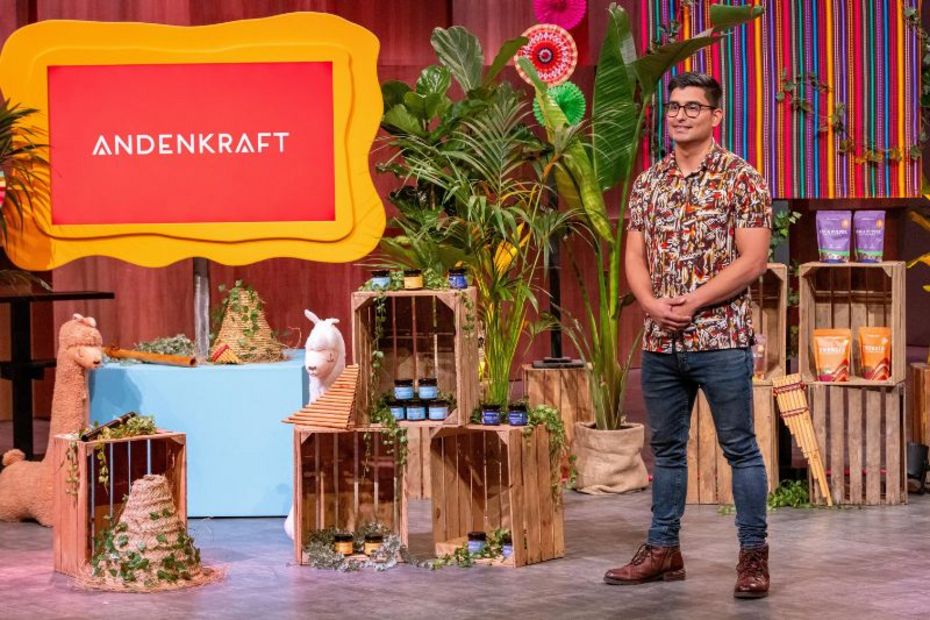
HSBA alumna Maren Gomez Moreno will probably never forget this moment: her partner in business and life, Justinian, presented their joint start-up, “Andenkraft”, to an audience of millions on Germany’s most famous start-up show, “Die Höhle der Löwen”. This TV appearance caused Andenkraft’s brand awareness to skyrocket in no time at all and significantly increased demand for products made from the yacon fruit of the Peruvian Andes overnight. In this interview, Maren tells us how she made it from the first presentation of her business idea in the ‘Consulting Project’ Master’s module to the public pitch stage on television.
From the Classroom to Television: HSBA Alumna Puts Andenkraft’s Yacon Products in the Spotlight
“The time spent studying, the inspiration I gained and the very practical nature of the course helped
me grow enormously as a person and laid many of the foundations on which we are building today.”
Maren Gomez Moreno, co-founder of Andenkraft
Andenkraft appeared on the TV show “Die Höhle der Löwen” this year. How did you feel when your co-founder Justinian presented your start-up to an audience of millions?
It was a very emotional moment for me. A mixture of pride, joy and also a certain amount of nervousness. Seeing Justinian standing there, not just presenting our product but also the story behind it, his family, our partners in Peru and our shared vision, was something very special.
At the same time, of course, you know: this is a once-in-a-lifetime opportunity. Millions of people are watching you at this very moment. And that’s exactly why, for me, it was above all a moment when I thought: Now we can show what we really stand for.
How did the idea for Andenkraft come about?
The idea for Andenkraft emerged from two worlds that came together for us. On the one hand, there is Justinian’s personal story: he grew up with Peruvian roots and experienced at an early age the role that plants and natural foods play in the Andean region. This knowledge has been passed down there for generations.
On the other hand, we observed everyday life here in Europe: many people want to eat more healthily, consume less sugar and improve their health, but most products in the supermarket are either highly processed or still full of sugar.
The key question for us was: Why is healthy eating often so complicated, and why are there so few natural alternatives suitable for everyday use? This is exactly what we associate with Andenkraft. We bring traditional plants such as the yacon root from the Andes to Europe, in a form that is simple, delicious and easy to incorporate into everyday life.
You did your Master’s at HSBA. Was there anything that particularly helped you with your start-up idea and still does today?
Definitely, especially the strong practical focus of the course. What helped me in particular was the opportunity to work on real business ideas whilst I was still studying and to test them time and again, whether in case studies or in pitch situations in front of lecturers and other students.
Courses such as Mike Fischer’s entrepreneurship course or product development in particular showed me how important it is not just to think through ideas theoretically, but to actually develop them further, seek feedback and adapt them.
Another key point for me was the decision to continue a project from my studies and seriously explore whether it could develop into a real business model. This mindset – of seeing things not just as a ‘university project’ but as a potential starting point for something bigger – has stayed with me to this day.
Did you secure the deal, and has anything changed for you and Andenkraft since the TV appearance?
We left the show having shaken hands with Judith Williams and Frank Thelen. Afterward, we engaged in more in-depth discussions. We haven’t yet reached a final strategic agreement, so the deal isn’t finalized at this point.
But what has definitely changed is the development of Andenkraft: The TV appearance gave us a huge growth boost, both in brand awareness and in direct customer reach.
We were able to reach millions of people who face exactly the challenge we want to solve: consuming natural, delicious, and simply less sugar to positively support their health.
At the same time, the increased demand has also allowed us to further expand our impact. Every purchase helps us continue to advance our water project in Lima and provide more families with access to clean drinking water.
What advice would you give to HSBA students who would like to pitch a business idea to investors themselves one day?
My most important piece of advice is: Just get started.
That doesn’t mean starting unprepared, but many people spend too long thinking, planning and perfecting. Especially at university, we’re often taught to analyse things very thoroughly, which is important too.
But entrepreneurship works differently: you learn the most when you start putting things into practice, make mistakes and iterate from there. I wish I’d taken that step sooner myself.
That’s why my clear recommendation is: test your ideas early on, talk to real customers, get feedback, and have the courage to go out there even with something that’s not quite finished, because in the end, it’s not the perfect PowerPoint that wins people over, but the ability to solve a real problem and develop a working business model from it.